Finance AI Systems Discuss one workflow
Governance

How governance works

For a finance workflow agent to be useful, Finance must be able to review and reproduce the work, IT must be able to see and govern the workflow, and the organisation must know what happens when something fails.

These controls are not a generic product added at the end. They are designed around the first workflow: what the agent can access, what evidence it must show, who approves, what IT monitors, and how errors are corrected or rolled back. The three questions are simple: what Finance must review, what IT must see, and how failures are handled.

Finance control

Reviewable and reproducible agent work

Finance does not need to trust a mysterious model answer. It needs to see enough of the work to challenge it, reproduce it, approve it, reject it, correct it, or escalate it.

For each workflow case, we define what Finance needs to see: source evidence, checks performed, exceptions found, draft output, visible rationale, and reviewer decision.

What Finance should be able to inspect

  • which source files, reports, policies, transactions, or reconciliations were used;
  • which validations, reconciliations, thresholds, policy checks, and completeness tests passed or failed;
  • which cases were clean, which need judgement, and which should stop or escalate;
  • what the agent proposes and what Finance approves, rejects, corrects, or escalates;
  • enough context to trace the output back to evidence and reproduce the conclusion.
IT visibility

The workflow, access, and operations

IT needs visibility before it can govern the workflow. That means knowing which agents exist, which workflows they support, who owns them, what they can access, what they have done, and what they cost to operate.

Some capabilities may come from your existing platforms. Some may come from open-source tooling. Some may need to be built for the workflow. The important point is that agent operations become visible, governed, and supportable.

What IT needs to govern

  • agent inventory, workflow owner, and operating stage;
  • tools, systems, data sources, environments, roles, and permissions;
  • clear distinction between read, draft, and action permissions;
  • run history, action history, logs, errors, usage, cost, and model/API route;
  • support owner, incident route, retention expectations, and change control.
Failure handling

Escalation, correction, and rollback

A credible agentic workflow needs a clear answer to: what happens when the agent cannot safely continue?

Some failures should stop the run. Some should escalate to Finance. Some should go to IT or support. Some require a corrected output. Some require reversal or rollback of an action taken in a connected system.

Failure paths to design before autonomy expands

  • Stop when required checks fail or the workflow is outside scope.
  • Escalate when human judgement, missing evidence, or policy interpretation is required.
  • Correct when the output can be amended before becoming authoritative.
  • Roll back or reverse when a system action has created an unwanted result.
  • Learn by updating instructions, tools, checks, permissions, or support route.

Permissions expand only when the controls are ready

Start with the safest useful version of the workflow, then expand only when evidence, review, IT visibility, monitoring, and rollback paths are in place.

Read-only

Read-only: the agent retrieves evidence, analyses cases, prepares explanations, and produces review packs without changing source systems.

Draft-first

Draft-first: the agent prepares journals, files, exception packs, reports, or workflow updates for human review before submission.

Controlled action

Controlled action: the agent performs bounded actions only where access, checks, approvals, logs, support, and rollback paths are in place.

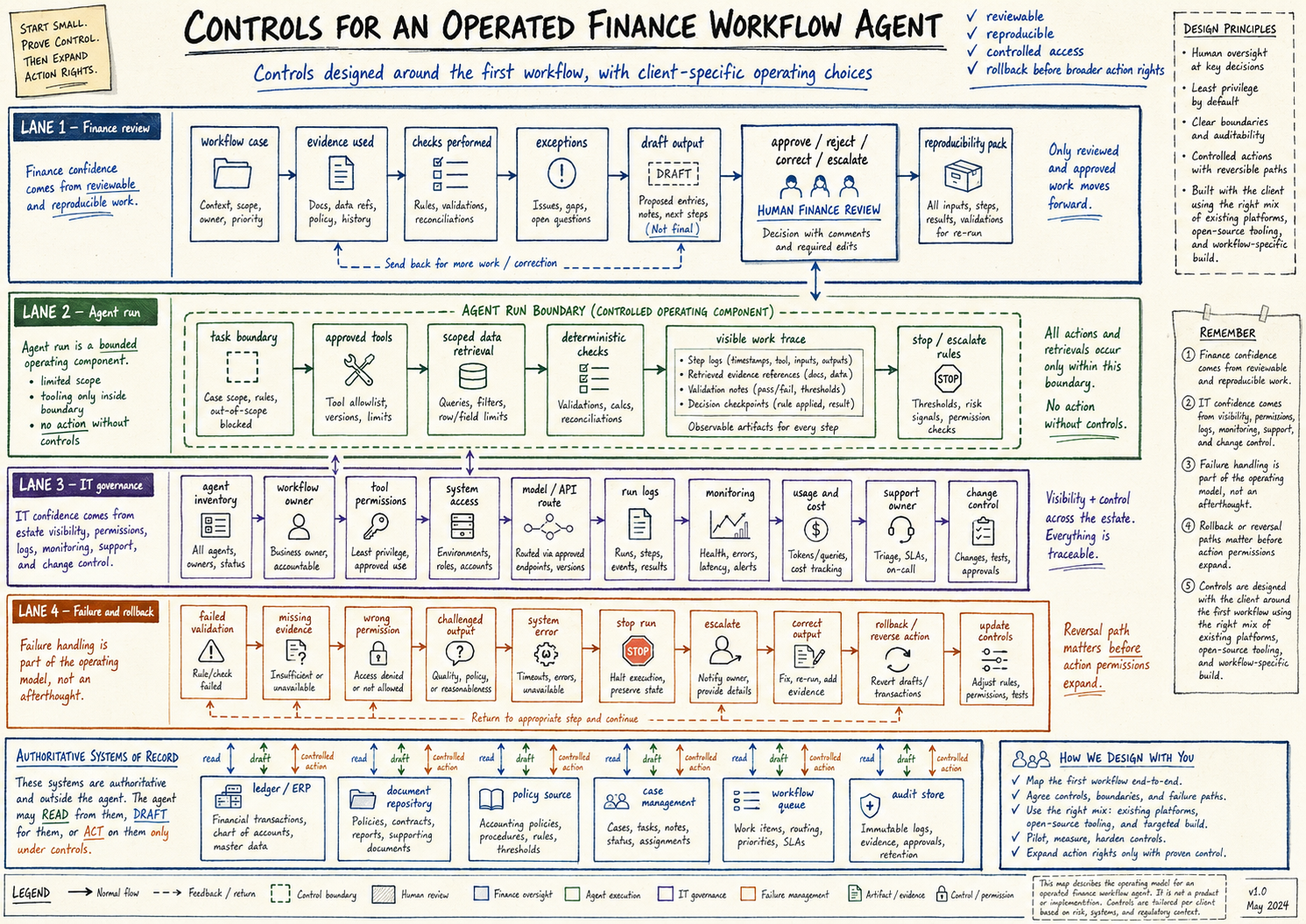
Reference governance map

This reference view shows how Finance review, the agent run, IT governance, and failure handling fit around an operated workflow agent.

Detailed controls reference map showing Finance review, agent run, IT governance, failure and rollback, systems of record, and design principles.

Reference only: open full-size if you need the detailed annotations.

Need to design governance for one workflow?

If one finance workflow is too manual, too brittle, or too dependent on people stitching systems together, start by designing the workflow, the evidence trail, the review points, the IT visibility, and the failure paths together.