Agent harness
Runs the workflow loop: task, context, tool choice, result reading, plan update, stop, continue, or escalate.
The AI work layer is not one model or one chatbot. It is a controlled execution layer between finance people and core systems.
It combines an agent harness, LLMs, deterministic tools, scheduled jobs, controlled system interfaces, logs, and review points. Its job is to execute bounded finance workflow steps while keeping ERP, TMS, consolidation, reporting tools authoritative.
Most of the AI work layer is bespoke to the workflow: the tools, checks, calculations, connectors, prompts, evidence outputs, and exception logic reflect the actual finance process. But not every component has to be built from scratch.
Finance directs and reviews the work; the AI work layer executes bounded tasks; core systems remain authoritative.
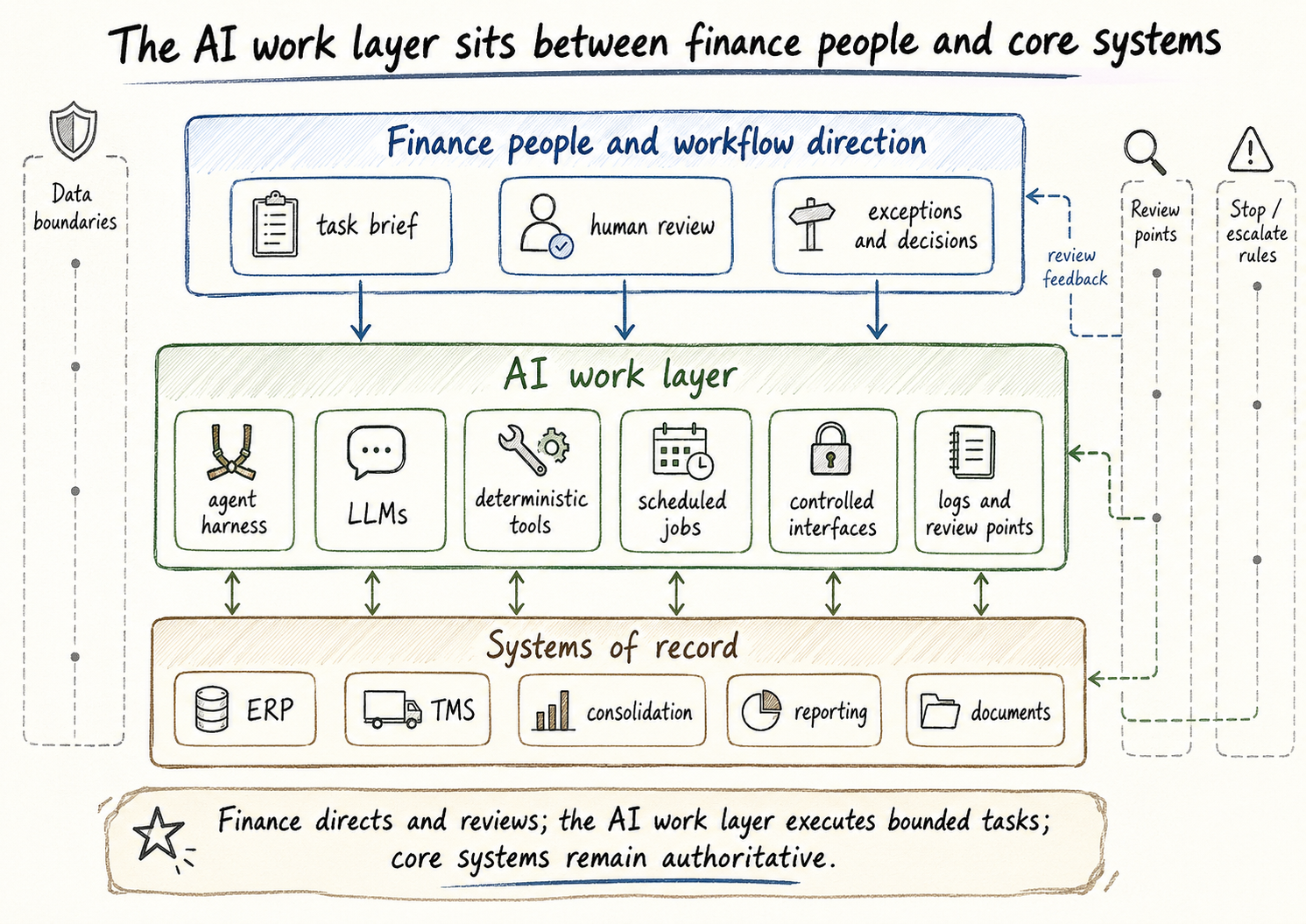
Finance directs and reviews the work; the AI work layer executes bounded tasks; core systems remain authoritative.
The AI work layer is the runtime around the model. The agent harness runs the loop: receive the task, inspect context, choose a tool, read the result, update the plan, continue, stop, or escalate.
Runs the workflow loop: task, context, tool choice, result reading, plan update, stop, continue, or escalate.
Handle interpretation, investigation, comparison, exception analysis, drafting, and coordination.
Handle balance fetching, calculations, reconciliations, validations, file transforms, and posting checks.
Keep recurring workflow steps running without manual prompting.
Connect the layer to finance systems without giving the model uncontrolled system access.
Record inputs used, tool calls made, checks passed, outputs drafted, and exceptions raised.
The model should not receive large raw data dumps. Tools retrieve only the scoped evidence needed for the task. Calculations happen in code, not in model reasoning.
The model can explain, compare, route, and draft. Exact numbers and control checks come from deterministic tools.
Coding agents are used to create and modify the tools, scripts, checks, connectors, and workflow automations that the AI work layer needs. The coding agent is part of how the layer gets built, not necessarily part of every production run.
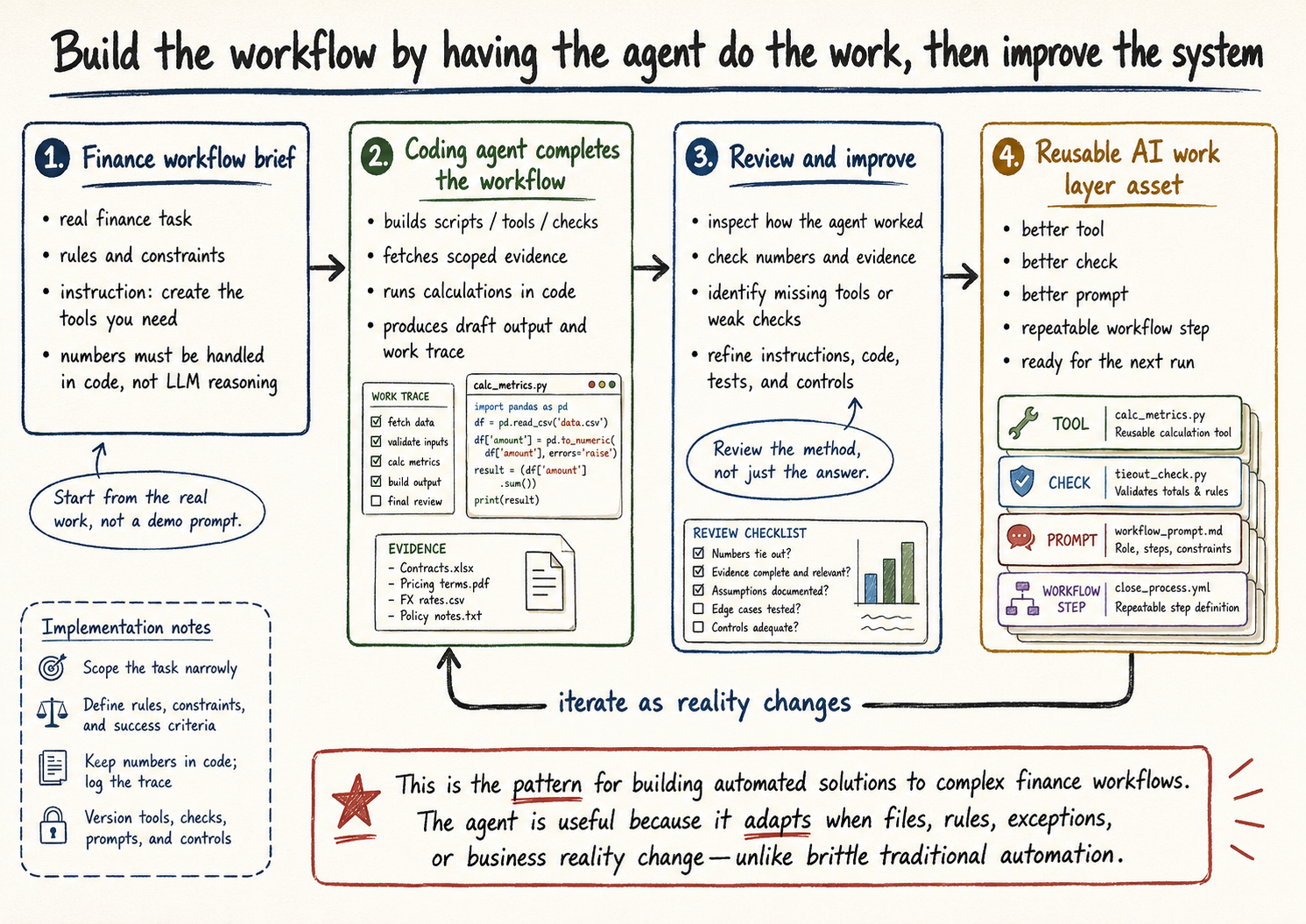
Build the workflow by having the agent do the work, then review the method and improve the reusable tools, checks, prompts, and workflow steps.
A workflow step, rule, check, exception, evidence need, or output requirement.
Create or modify a script, tool, connector, validation, test, prompt, or workflow automation.
A reusable tool or check that the AI work layer can call during a bounded workflow run.
Some capabilities are common across many agent systems, especially the audit/review interface and run trace, security and access controls, and the evaluation and validation harness. Each of these can be built bespoke, adopted from open source, or bought from a vendor depending on the workflow, risk level, integration needs, and your technology environment.
Shows what happened, what evidence was used, what checks passed, what outputs were drafted, and where a reviewer intervened.
Scope data access, tool permissions, sensitive-data handling, prompt and input filtering, and stopping the model from receiving or doing things it should not.
Checks calculations, reconciliations, completeness, policy consistency, evidence sufficiency, and whether the agent should continue, stop, or escalate.
This is not a pure custom-code pitch or a product wrapper. Bespoke workflow logic sits on reusable agent-system components where they make sense.
Finance people should increasingly be able to specify, inspect, and even create parts of the workflow logic. They will work closer to code: rules, tools, checks, prompts, test cases, and evidence outputs.
The target is not “finance becomes software engineering”. The target is finance owning workflow logic inside proper technical rails.
If one finance workflow is too manual, brittle, or dependent on people stitching systems together, start by designing the controlled AI work layer around that workflow.